
Saving the Mindo Harlequin Toad
Conservation focus:
Mindo Harlequin Toad
Scientific name:
Atelopus mindoensis
Scientific classification:
Amphibian, Anura, Bufonidae
IUCN status:
EDGE status:
CR (critically endangered)
Rank 525/1015 EDGE amphibians
Threatened evolutionary history:
3 million years
Conservation priority by EDGE rank / ecosystem


Why it matters
A no-brainer. Firstly, the project site is an EDGE, biodiversity and endemism hotspot. Secondly, the target is an amphibian, a taxon commonly neglected in conservation funding. Thirdly, the currently known global population of just 14 (!) critically endangered Mindo harlequin toads teters on the very brink of extinction.
This EDGE species, thought to be extinct for 30 years but recently rediscovered, embodies 3 million years of independent evolution and threatened evolutionary history. If this gem is not worth saving, then what is?
Finally, this project uses eDNA to generate the first genetic baseline for the Mindo Harlequin Toad using eDNA, providing critical information on the species'genetic diversity and population structure. A novel, promising approach for guiding in situ conservation management strategies and supporting long-term genetic monitoring. It may also help finding refuges of rare species (as done by another 1wild grantee in the Philippines).
Project fast facts
Focal species' population trend
Unknown
Local conservation attention
Low
Range / Project area

Ecological role
This small toad is a key indicator of cloud forest and freshwater ecosystem health. As both predator and prey, it helps regulate insect populations and supports the food chain. Its tadpoles contribute to nutrient cycling in mountain streams.
Threats
The main threat to the Mindo Harlequin Toad - rediscovered in 2019 after having last been seen in 1989 - is its extremely small and isolated population. The establishment and expansion of the Arlequín Reserve has already secured and restored the species' remaining known habitat, significantly reducing the immediate risk of habitat destruction. Due to a critically low population size, the species is now highly vulnerable to genetic bottlenecks, low reproductive success, environmental stochasticity, and disease outbreaks.
A key threat is Chytridomycosis, a deadly fungal infection of amphibians. First seen in Australia in 1993, it has affected about 30% of the amphibian species of the world, causing dramatic population declines and extinctions of amphibian species in North, Central and South America, eastern Australia, east Africa and the Caribbean. The fungus can cause 100% mortality in some populations. No effective measure is known for control of the disease in wild populations.
Grant
First awarded:
$ 8,600
9 August 2026
Rank 525/1015 EDGE amphibians
Programme owner
Khamai Foundation
Programme contact
Gabriela Sandoval

Project location
South America, Ecuador
X7GG+4M Reserva Arlequín, Tandayapa, Ecuador
Addressing the need: Project goals
Our current conservation efforts focus on intensive population monitoring, and supporting in situ recovery actions to increase the species' long-term viability.
Objective 1: Increase the relict population of the Mindo Harlequin Toad.
Objective 2: Maintain and improve suitable habitat for the toad.
Objective 3: Safeguard the species' genetic diversity through eDNA.
Objective 4: Reduce disease-related extinction risk of the toad.
Through this project, we are seeking to generate the first genetic baseline for the Mindo Harlequin Toad using eDNA.
Conservation actions
This project is expected to provide critical information on the species'genetic diversity and population structure, helping to guide in situ conservation management strategies and supporting long-term genetic monitoring.
Ultimately, the project will enhance the scientific knowledge needed to improve the species' resilience and contribute to its long-term survival in the wild after its near-extinction period.
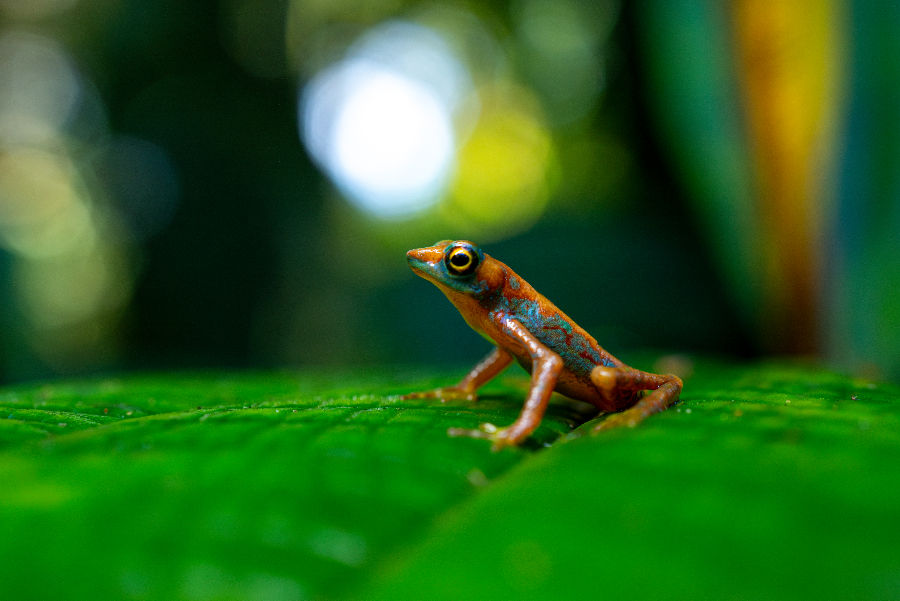
Tyrone, of of only 14 survivors found after the Mindo Harlequin Toad was thought to be extinct for 30 years. Photo: ©David Jacome
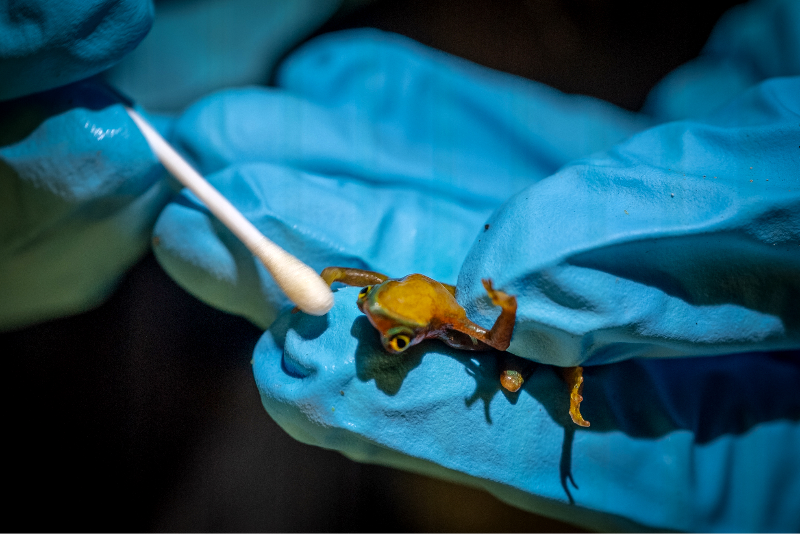
DNA swabbing and eDNA sampling are used to establish the first genetic baseline of the extremely rare Mindo Harlequin Toad. Photo: ©David Jacome

These toads and tadpoles were found in what is now the Arlequín Reserve in the Santa Rosa River region near Mindo, Ecuador. © Khamai Foundation
Tyrone, of of only 14 survivors found after the Mindo Harlequin Toad was thought to be extinct for 30 years. Photo: ©David Jacome