
Protecting 16 EDGE species in an EDGE hotspot
Conservation focus:
9 salamanders, 4 frogs, 1 lizard, 1 mammal, 1 conifer
Scientific name:
Chiropterotriton nubilus (CR), Chiropterotriton chiropterus (CR), Isthmura naucampatepetl (CR), Parvimolge twonsendi (VU), Thorius pennatulus (EN), Thorius munificus (CR), Aquiloeurycea cafetalera (VU), Pseudoeurycea lineola (EN), Pseudoeurycea lynchi (EN), Megastomatohyla mixomaculata (EN), Tlalocohyla godmani (VU), Craugastor spatulatus (EN), Incilius cristatus (EN), Abronia graminea (EN), Megadontomys nelsoni (EN), Podocarpus matudae (VU)
Scientific classification:
Amphibians, Reptiles, Mammals, Gymnosperms
IUCN status:
EDGE status:
4 CR, 8 EN, 4 VU
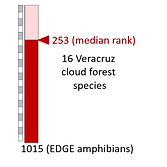
16 species, median score 11, median rank 253 (range 54-993) / 1015 EDGE amphibians
Threatened evolutionary history:
Median: 6 million years
Conservation priority by EDGE rank / ecosystem



Why it matters
This programme protects the last remnants of Montane Cloud Forest in Central Veracruz, an EDGE zone harbouring 16 EDGE species (mostly rare, endemic amphibians). Its humid, montane habitats suffer from ongoing destruction and fragmentation. Conserving their biodiversity is vital to maintaining ecological balance, soil and water quality, as well as the integrity of these sensitive ecosystems. The 16 focal species play key roles as invertebrate controllers, prey in food webs, bioindicators of environmental health, and as nutrient recyclers. Many of them are unique to Mexico, making these exceptional habitats irreplaceable for conserving evolutionary history.
Project fast facts
Focal species' population trend
Stable to decreasing, dependent on species
Local conservation attention
Locally high
Range / Project area

Ecological role
Depending on species; invertebrate controllers, prey in food webs, bioindicators of environmental health, and nutrient recyclers.
Threats
Ongoing destruction and fragmentation through deforestation, logging, and expanding agriculture and human settlements reduce habitat quality and connectivity. Further threats result from climate change altering temperature and humidity regimens critical to amphibian survival, and emerging diseases, especially chytridiomycosis (fungal infection with Batrachochytrium dendrobatidis which is fatal for amphibians). Taken together, these threats reduce population viability and undermine the ecosystem services provided by Montane Cloud Forests, such as water regulation, climate moderation, and carbon sequestration.
Grant
First awarded:
$ 10,000
20 July 2025
16 species, median score 11, median rank 253 (range 54-993) / 1015 EDGE amphibians
Programme owner
Integra Socioambiental, Xalapa, Mexico
Programme contact
Dr. Jorge Antonio Gómez Díaz

Project location
Mexico
Pablo Sidar 15, Adalberto Tejeda, Xalapa-Enríquez, Ver., Mexico
Addressing the need: Project goals
Preserve the Montane Cloud Forests in Veracruz and their endemic amphibian fauna through habitat protection, community involvement, and restoration.
The Montane Cloud Forest in Veracruz is a globally unique ecosystem with exceptional biodiversity, high levels of endemism and a high number of evolutionarily unique and globally endangered (so-called EDGE) species, which are essential for its ecological functioning. Immediate conservation action is needed to protect these extraordinary habitats (and many vital microhabitats) from further fragmentation, degrading and destruction through deforestation, logging, and the expansion of agriculture and human settlements.
Conservation actions
This programme will use a combination of short- and long-term indicators, the former including habitat monitoring (regular surveys), species monitoring (changes in abundance and range), community engagement (awareness-building and encouraging the adoption of sustainable practices), and ecotourism (tracking of visitor numbers and income generated). Long-term impact measurements include biodiversity surveys, evaluation of forest regeneration, tracking of sustainable land use practices and resource management through environmental management units, and evaluating the impact of conservation on ecosystem services such as carbon sequestration and water retention.

Waterfall in the Montane Cloud Forest of Central Veracruz, an EDGE hotspot

Brooks of the montane cloud forests of Central Veracruz are key habitats for many EDGE species, especially endemic salamanders and frogs.

Cataract in the Montane Cloud Forest of Central Veracruz, an EDGE hotspot
Waterfall in the Montane Cloud Forest of Central Veracruz, an EDGE hotspot