
Integrating science and community stewardship for the Gharial in Nepal
Conservation focus:
Gharial
Scientific name:
Gavialis gangeticus
Scientific classification:
Reptiles, Crocodiles, Gavialidae
IUCN status:
EDGE status:
CR (critically endangered), CD
Rank 1 of 6 EDGE-listed crocodylians
Threatened evolutionary history:
25 million years
Conservation priority by EDGE rank / ecosystem


Why it matters
The gharial needs all the help it can get. It's the top conservation priority among crocodylians, a unique species within an old, unique taxon of only 26 representatives.
With a global population of less than 1000 individuals scattered over severely fragmented habitats across a dozen river systems in Nepal, India and Bangladesh, this highly acquatic, fish-eating crocodylian is on the very brink of extinction. Already extinct in Pakistan, Myanmar and Bhutan, this riverine apex predator used to function as a keystone species by modifying riverbank habitats, preying on fish, and dispatching hatchlings and eggs as prey items, as well as nutrients into the food web.
The project funds will help us understand the population size, structure, and reproductive ecology of gharials in one of their remaining key habitats, and will foster awareness and community stewardship for protecting this extremely rare species.
Project fast facts
Focal species' population trend
Increasing from very low levels
Local conservation attention
Low
Range / Project area

Ecological role
Gharials are an ‘indicator species’ for the health of freshwater ecosystems in their range. They are also an ‘umbrella species’, as conservation of gharials will help safeguard several other endangered species, such as the mugger crocodile, freshwater dolphin, smooth-coated otter, etc., thus having far-reaching benefits for the entire freshwater ecosystem. Moreover, as an apex predator that feeds primarily on fish, gharials can help maintain healthy fish populations.
Threats
Gharials have undergone a drastic decline of over 80% in their historic population size (from >20,000 to 650) and extent of occurrence (from >40,000 to 5,000 km2) globally (Lang et al. 2019). The population of gharial in the Babai-Karnali River system is one of only two extant gharial populations in Nepal. In and around the Bardiya National Park (BNP), gharials face threats such as dams and barrages construction, sand mining, boulder extraction, unlicensed fishing, and mortality in fishing nets (Bashyal et al. 2021). More recently, river-interlining, which includes siphoning water from the cold water system river Bheri into the warm water river Babai, and climate change (that could impact temperature-dependent sex determination mechanisms in the gharial) have also emerged as threats. Importantly, in the face of these pressing threats, gharial conservation in BNP is affected by the lack of scientific information on their population and the lack of awareness among local communities.
Grant
First awarded:
EUR 7'230
1 February 2026
Rank 1 of 6 EDGE-listed crocodylians
Programme owner
Biodiversity Conservancy Nepal
Programme contact
Ashish Bashyal

Project location
East Asia
Bardia-Nationalpark, Nepal
Addressing the need: Project goals
Our goal is to substantially contribute to long-term conservation of gharials in and around Bardiya National Park by generating new and relevant information on various ecological attributes of their populations, and building community capacity for gharial conservation.
Key goals include an assessment of the status of gharials in the Babai and Karnali Rivers, researching the reproductive ecology of gharials , and fostering community stewardship for the protection of gharial and their riverine habitats.
a. Population assessment: We will assess the current status of wild resident and captive released gharials in the Babai and Karnali Rivers by estimating their population size, structure, sex ratio, and survival rates.
b. Reproductive ecology: We will investigate the reproductive ecology of gharials by assessing the status of their breeding, nesting, reproduction, and recruitment.
c. Community capacity building: We will foster community stewardship for protection of gharials and their habitats by conducting citizen science programs.
Conservation actions
Gharial conservation in BNP is hindered by a lack of information on various ecological attributes of their population. Information generated from this project will be crucial in assessing the viability of gharial populations, estimating survival rates of captive released gharials, identifying important basking and nesting areas, identifying threats, and understanding the spatial distribution of gharials. Similarly, outreach and training are expected to raise awareness regarding gharial conservation in local communities. This will be helpful in taking conservation actions, when needed, such as population reinforcements by releasing captive-reared gharials, ensuring protection of optimal habitat, incorporating climate change adaptation programs for gharial conservation, and conducting regular patrols to curb illegal activities, including fishing. All these collective actions will ensure that healthy and protected populations of gharials thrive in Nepal in
the long-term.
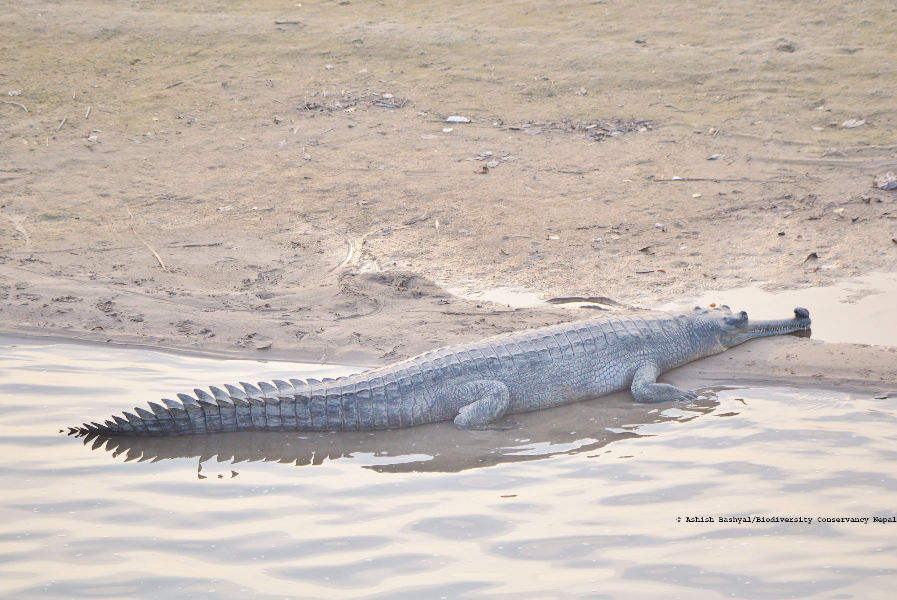
Critically Endangered and Critically Depleted Gharial (Gavialis gangeticus), the top conservation priority among crocodylians.

Gharials used to grow to a body length of 6 m in times past.

Building community awareness and support for gharial conservation are critical to protect this critically endangered species.
Critically Endangered and Critically Depleted Gharial (Gavialis gangeticus), the top conservation priority among crocodylians.